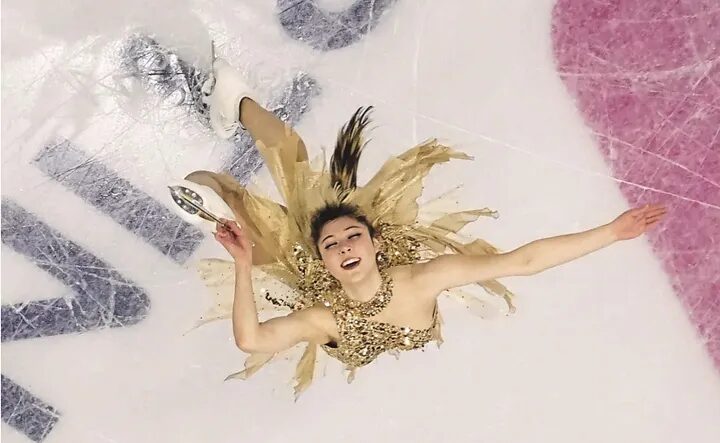
On the stage where Olympic medals are contested, Alysa Liu’s relaxed performance and soft expression felt very fresh to me. I felt that at her core lies a free-thinking approach not bound by the framework of competition, and an attitude of not leaving the judgment of her performance’s quality up to others. And I feel that her words contain various suggestions that people involved in sports should consider.
“Think of a singer. They perform all the time, but they don’t get scored, you know. I think of it. That’s how I think of competitions. I cannot bring myself to see other skaters as competitors. We are just all independent artists” (Quote from TV Asahi)
As someone who specialized in the 100m sprint, I used to think similar things. It is certainly possible to evaluate performance using the objective metric of time. However, time is greatly influenced by uncontrollable conditions such as wind and humidity. Therefore, I viewed the 100m sprint as something akin to self-expression like dance, in that the goal is ultimately to reproduce one’s ideal movements.
In fact, building one’s body through daily diet and sleep, performing repetitive practice to establish ideal movements, and sprinting down the track with a trained body and mind — one could say that such a physical form is a crystallization of that person’s time (i.e., life) up to that point.

(Caption: Meals with balanced nutrition literally build an athlete’s body)
What is the “Self” in the First Place?
The question “Who am I?” is one that many people have asked. The French philosopher Descartes is famous for leaving us the phrase “I think, therefore I am (Cogito, ergo sum),” and he argued that an “autonomous, consistent, and rational self” exists.
For example, if you ask an athlete the previous question, they would likely answer, “I am an athlete (tennis player, professional athlete).” Particularly for athletes, they think about their sport even outside of competition time, such as regarding their diet and lifestyle, and their identity as an athlete serves as a major guide for their thoughts and actions.
The Difficulties of Living with the “Self = Athlete” Identity
When it comes to athletes participating in the Olympics, it’s not uncommon for them to prioritize practice from a young age and be isolated from academics and after-school play.
As a result, their time outside of sports is limited, and their friendships naturally tend to revolve around sports. They end up living in a kind of sports bubble, which I think has the advantage of allowing them to focus on their sport and making it easier to receive support from those around them.
On the other hand, isolating oneself in this bubble also carries risks. This is because when they have to step away from competition due to injury or retirement, they must face a “self with sports removed.”
It is said that when various capital, such as past friendships and income, has been tied to sports, being suddenly cut off from that sport can lead to the illusion that one has nothing left. The following paper, in particular, points out the risks after retirement.
The prevalence of mental health symptoms among retired athletes is well documented, with studies reporting elevated rates of depression, anxiety, and sleep disturbances in the early years post-retirement (Enoiu, R. S., & Aidar, F. (2025)
A strong identity as an athlete may work well while competing, but it also has the potential to narrow one’s possibilities after retiring from the sport.
Trying to Grasp “Oneself” Broadly
In order to avoid the risk of relying on a single self, defining a broader self would be one method. In the case of Alysa Liu mentioned at the beginning, she views herself not as a “figure skater” but as an “artist.”
If you are an artist, there is no need to be bound by winning or losing, and there is no need to stick to skating as a method of expression in the first place. Even if things don’t go well in competitive skating, she won’t lose her “artist” self by continuing to express herself through other methods like words or dance.
Playing Multiple “Selves”
On the other hand, having multiple selves also contributes to making life easier for athletes. Canadian sociologist Erving Goffman believed that the self is constantly changing and cannot possess certainty or consistency. He viewed social life as a “performance,” where there is no fixed, true self, but rather we are merely playing roles and adapting to the environment of the moment.
I myself consciously held both a “self as a student” and a “self as an athlete.” This was because when things weren’t going well in one area, I could “escape” to the other.

(Caption: Alysa Liu is studying psychology at UCLA)
Even if I devoted 100% of my life to track and field, because it’s a sport, there will inevitably be times when I don’t get the results I want, or I get injured. I felt that in those moments, I would end up rejecting myself. That’s why, in order to maintain my mental hygiene, it was very important to create a place for myself in both sports and academics.
In fact, research has shown that athletes who think about their post-retirement careers while still active make a smoother transition. Advancing one’s education, undergoing vocational training, and building new human relationships both inside and outside of sports all contribute to a smooth career change after retirement.
Conclusion
I don’t think we should completely deny finding virtue in the “success” achieved after sacrificing many things. However, if the sacrifice is too great, leading to mental and physical exhaustion and making it difficult to even continue competing in the first place, isn’t that putting the cart before the horse?
Taking a step back to understand who you are, or creating a place for yourself in academics or business apart from competition, can lead to creating a mental escape route or breathing room. I think it is also important to distance oneself from the narrow self-understanding of “sports player = a disciplined athlete.”
Leave a Reply